AI workflow automation
Classify, extract, draft and take bounded actions inside the real queue. Deterministic checks and human approval handle uncertain cases.
We build AI for document processing, knowledge search, forecasting and controlled agents. It connects to the systems and review points your team already uses.
Classify, extract, draft and take bounded actions inside the real queue. Deterministic checks and human approval handle uncertain cases.
Read invoices, delivery notes, contracts and forms, then check and send the data to your systems. Incomplete or unusual records go to a person for review.
Answer questions from policies, product records and case history. Each user sees only the sources they can access, with evidence alongside the answer.
Turn demand, stock, workload and margin data into forecasts and exception queues, so the right person can act in time.
AI belongs where the work happens. We connect it to your ERP, WMS and internal tools, so results arrive in the workflow instead of another dashboard.
Deployments run in your AWS environment. We document where data goes, how long it is kept and whether a provider can use it to improve a model.
We measure hours saved and errors prevented, not impressive screenshots. Every system has repeatable evaluations, monitoring and a fallback path.
Score one repeated workflow, not an ambition such as "use AI". A useful first pilot has visible value, representative examples, a measurable answer and a safe place for a person to review uncertainty.
Every slider starts at 1 for an unproven assumption. Replace it with evidence from the people, records and systems involved in the real process.
The workflow may be too rare, poorly bounded or difficult to evaluate for a useful first AI pilot. Improve the baseline, examples, access or ownership before selecting a model.
Send the result and your optional context to ORBN for a personal response.
This scorecard is directional. It does not prove feasibility, lawful use, model quality, data rights or return on investment. A severe risk can rule out a pilot regardless of the total.
The model is one component. A working system also needs to know where inputs arrive, which records it may use, how to check an answer and where the work goes next.
Read invoices, delivery notes, forms, contracts or correspondence. Extract the fields that matter, check them against business rules and send exceptions to the right person.
Let teams question policies, product records, technical documents or case history with answers tied to permissioned source material and links back to the evidence.
Classify incoming requests, find relevant account context, propose a response and route unusual or sensitive cases for approval inside the service workflow already in use.
Use operational history to estimate demand, workload, risk or margin, then surface the forecast with confidence, assumptions and an action a planner can accept or adjust.
Gather context across ERP, WMS, CRM or internal tools, prepare the next action and execute only the bounded steps the system and user are authorised to take.
Add summarisation, classification, recommendations, natural-language reporting or a domain copilot to software people already trust, instead of creating another isolated chat window.
The right proposal may recommend less AI. We use the simplest approach that meets the operational and assurance needs, then combine methods where the workflow calls for it.
Scroll horizontally to compare the approaches →
| Approach | Use it when | Output | Control to require |
|---|---|---|---|
| Rule-based automation | Inputs and decisions can be specified exactly | Deterministic and repeatable | Tests for every rule, exception and integration failure |
| AI-assisted workflow | Language, documents or patterns need interpretation | Proposal, classification or extraction with uncertainty | Evaluation threshold plus human review for low confidence |
| Agentic workflow | Several bounded steps must be selected and coordinated | Actions across approved tools and records | Least-privilege tools, limits, approvals, logs and a stop path |
| Predictive model | Historical signals can estimate a defined future outcome | Forecast, probability or ranking | Back-testing, drift monitoring and accountable user judgement |
| Custom software without AI | The constraint is workflow, interface or system connectivity | Exact application behaviour | Conventional acceptance, security and operational testing |
Observe the real queue, exceptions, systems, review effort and consequence of error. Agree the value measure and name the process owner.
Select representative and awkward examples, define accepted outcomes and separate task quality from safety, privacy and operational release criteria.
Compare suitable models and the simplest architecture on real inputs. Test retrieval, latency, cost, permissions and failure modes before polishing a demo.
Put the capability in front of real users with a review queue, feedback capture and deterministic checks around the model's uncertain output.
Connect identity, data and downstream actions with least privilege. Meet the agreed thresholds, document limitations and rehearse fallback and support.
Monitor task quality, exceptions, latency, model cost and user behaviour. Re-evaluate when prompts, source data, models or the business process change.
Controls depend on the use case, data and consequences. Before a system can influence real decisions, each of these six questions needs a clear owner and evidence.
Define intended use, prohibited use, users, inputs, outputs, tools, approval points and the consequence of plausible failure.
Document sources, lawful purpose, permissions, provider processing, retention, residency and whether prompts or outputs can be used for model improvement.
Use repeatable representative tests, failure categories and thresholds for task quality, security, privacy, fairness or explanation where each is relevant.
Give reviewers the source context, uncertainty and authority to correct, reject, stop or fall back without creating an invisible rubber stamp.
Treat retrieved content and user input as untrusted, limit every action, validate parameters and prevent the model from granting itself broader access.
Log useful events without leaking sensitive data, monitor quality and cost, manage model or prompt change, and maintain an incident and decommissioning path.
Useful references include the NCSC's secure AI system development guidelines, the ICO's AI and data protection risk toolkit, the UK government's AI Management Essentials guidance and the AWS Responsible AI Lens. These are starting points, not substitutes for legal, regulatory or sector-specific advice.
Model usage is one line item. Most of the work sits in data access, testing, integration, assurance, user experience and the route for uncertain or failed output.
Workflow mapping, representative examples, data and provider review, baseline measures, evaluation design and the hardest technical test.
User interface, model and retrieval work, validation, a review queue, limited integration, feedback and an explicit pilot decision.
Identity, production integration, monitoring, incident response, model calls, storage, support, evaluation and controlled change.
A four-week pilot can work when examples are ready, the boundary is narrow, integration is limited and a reviewer is available. It is not a responsible promise for every production system. Use the UK software delivery cost estimator to test the team, duration and risk assumptions behind a proposal.
AI prepares incoming messages as structured sales orders. Uncertain matches stay visible, and a person confirms each order before it becomes live. Teams start the day with the reading and re-entry already done.
Read the Crowbond order processing case study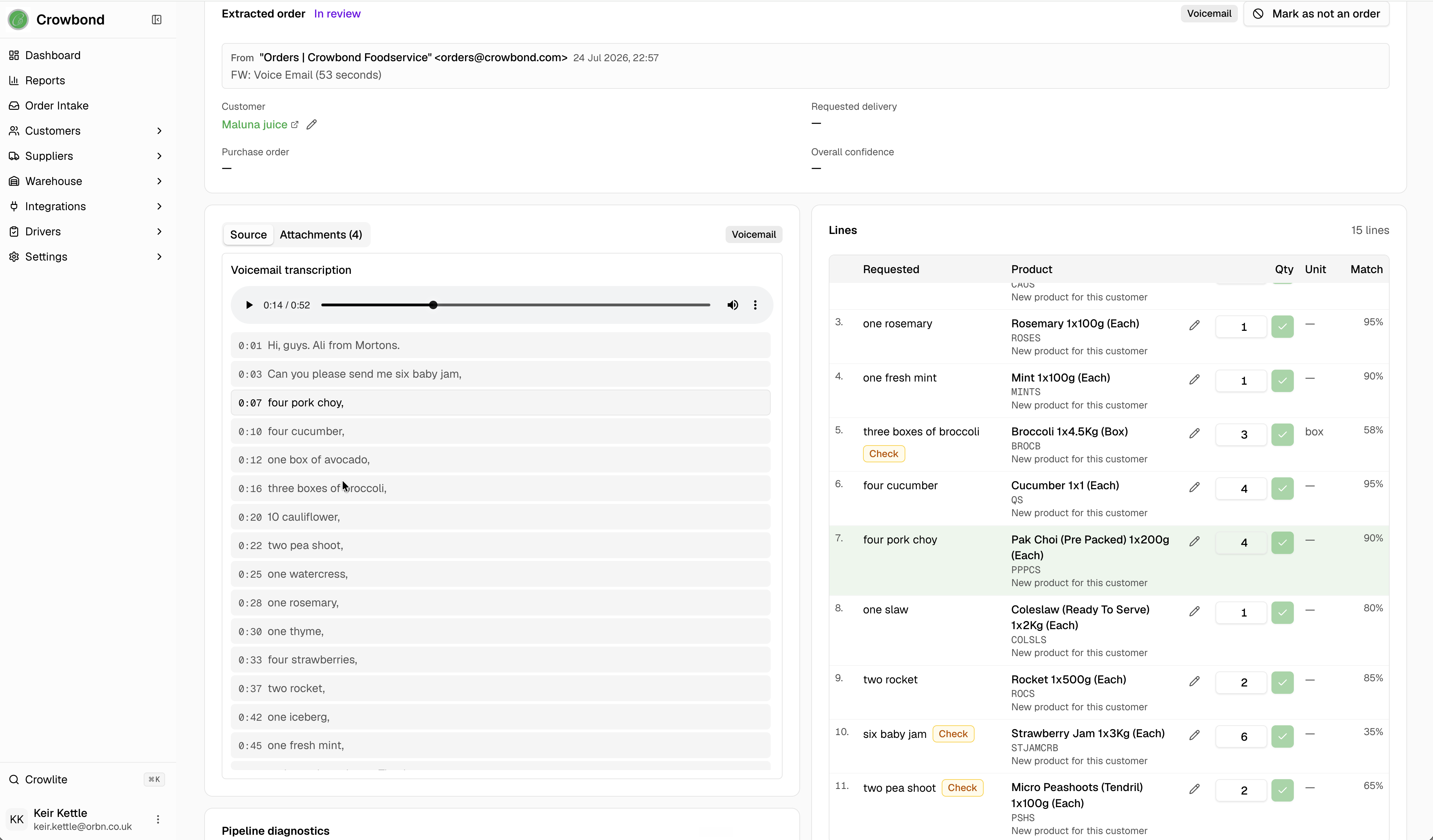
New orders no longer wait to be re-keyed each morning.
Teams save time every day by removing repetitive manual entry.
Automated extraction significantly reduces mistakes caused by re-keying order details.
The queue is processed before the day begins, removing early pressure from the team.
Higher order volumes no longer require the same increase in administrative headcount.
For every 200 orders, removing manual processing can save up to six hours.
Actual time saved will vary with order format, order complexity and the existing process.
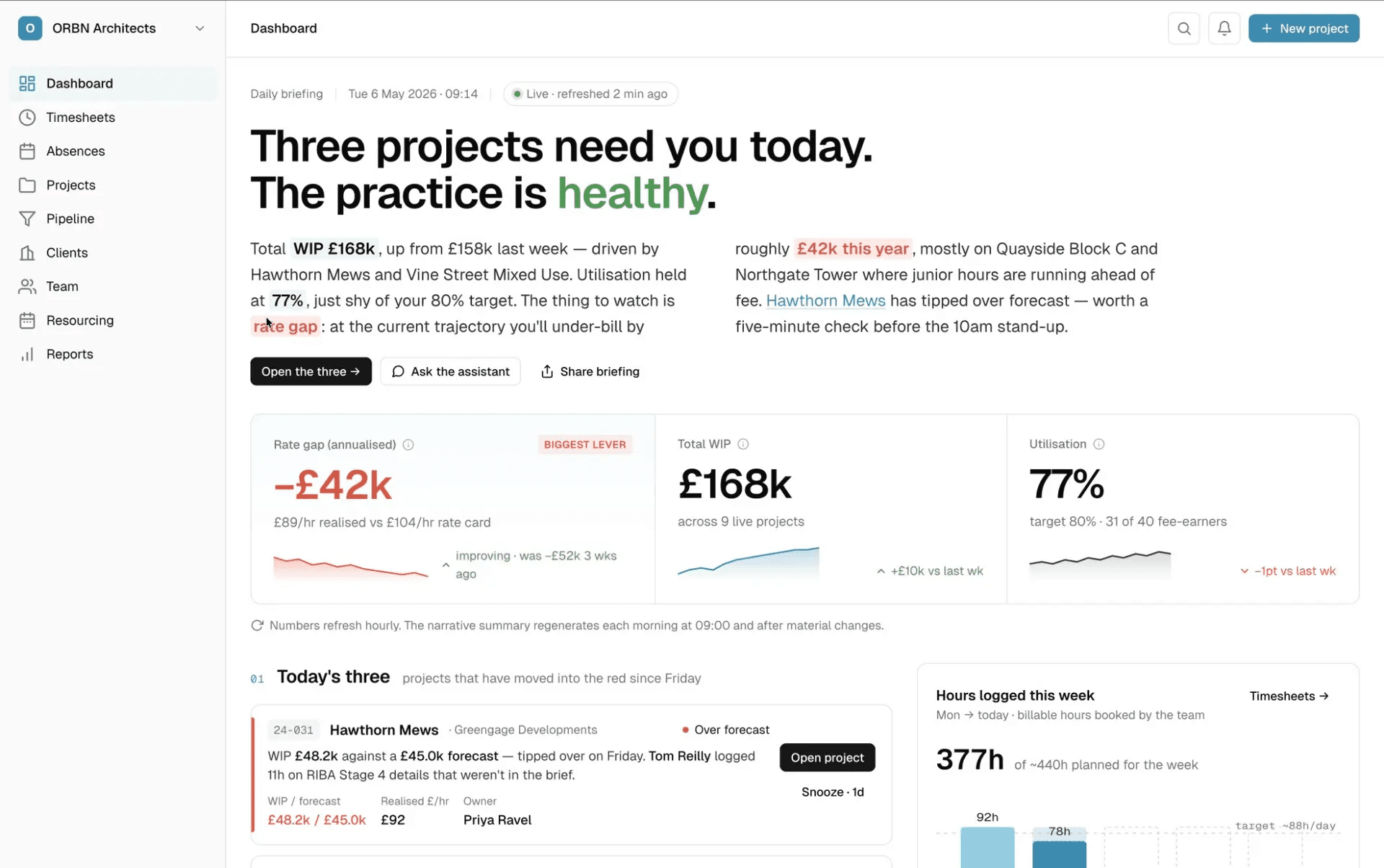
DeskBook combines timesheets, work in progress, budgets and project data into a plain-English briefing for architecture practices. It shows which jobs need attention and what to inspect before stand-up, while the underlying records remain available for the person making the decision.
An AI development company starts with a specific business problem. It prepares the data and tests, chooses a suitable model, builds the surrounding software and connects the result to existing systems. A production system also needs permissions, monitoring, human review and failure handling.
Good candidates are repeated tasks involving documents, language, images, forecasts or large bodies of knowledge. Examples include classifying enquiries, extracting invoice data, drafting responses and searching internal policies. If the rules can be written down exactly, conventional automation is often cheaper and more reliable.
Ordinary automation follows exact rules. AI helps when inputs vary or a task depends on language, images or patterns. Many dependable systems use both. AI interprets or proposes, conventional software checks and routes, and a person handles uncertain or high-consequence decisions.
Cost depends on the workflow, data access, integration, testing, user experience and operating needs. The model is only one part of the system. A useful proposal separates discovery, a bounded pilot, production integration and ongoing usage. A document classifier and an operational agent have very different scope and risk, so ORBN does not publish a single AI price.
A focused pilot can sometimes take about four weeks when real examples are ready, the workflow is narrow and a person can review uncertain results. Production usually takes longer. Identity, integration, security, testing, change management and support all need to work before release. The first estimate should show which of those conditions already exist.
Not if the system is designed and contracted correctly. Before any data is sent, the architecture and contract must state which provider processes it, where it is stored, how long it is kept, whether it can improve a model and who can access prompts and outputs. ORBN designs deployments in the client AWS environment and documents the data path and service terms.
Usually not. A managed foundation model or established machine learning service can handle many business use cases when it is combined with your own data, rules and workflow. Training or fine-tuning makes sense only when tests show a gap that simpler approaches cannot close.
Start with representative inputs, accepted outcomes and clear failure categories. Run the same tests before each release, set thresholds and include unusual or hostile inputs. Keep a human review or fallback path. Testing continues after launch because changes to models, prompts, source data and user behaviour can change the result.
If the workflow cannot yet access dependable records, start with data strategy and systems integration, and use AWS cloud application development when the production environment, deployment, recovery and operating controls are part of the missing capability. AI cannot repair an undefined source of truth or an unowned connection by itself.
How retrieval, knowledge graphs and source context can support more useful answers over connected business information.
R/02Why AI creates value when it is connected to the records, decisions and operational feedback already inside the business.
Bring the business outcome and representative examples. We will test whether AI is the right response and define the evidence a useful pilot must produce.