Incoming messages
Orders share the inbox with replies, invoices, remittances and general customer messages.
Crowbond Foodservice needed three people working full time to read customer emails, listen to voicemails, decipher handwritten lists and type orders into its system. Order processing had become a significant bottleneck for growth. ORBN built an AI-powered intelligent order processing pipeline to handle that work. Now one person needs only around 2.5 hours a day to review the 400 incoming orders.
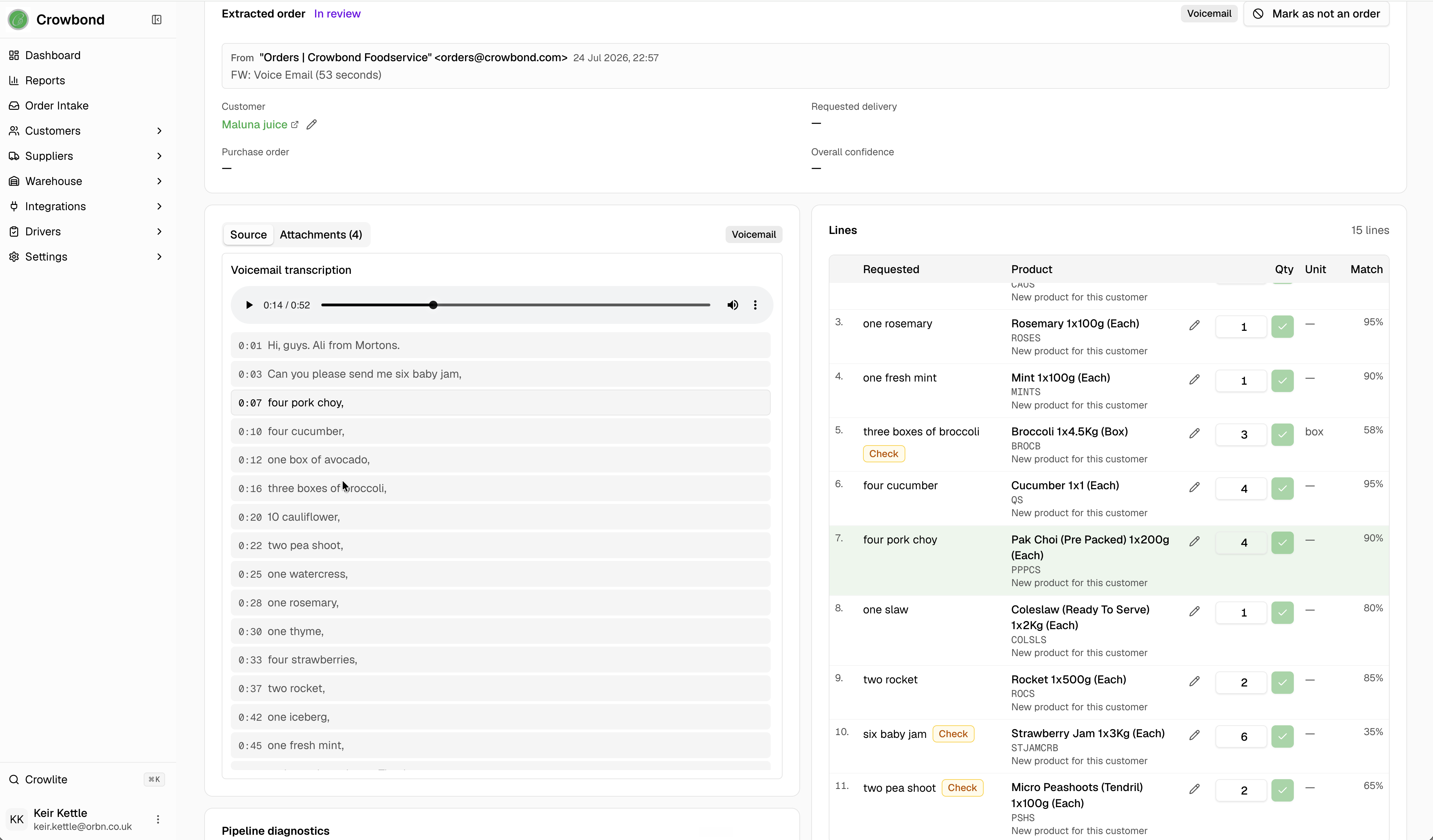
Orders share the inbox with replies, invoices, remittances and general customer messages.
Each order still needs the right customer, product, pack size and quantity before it can reach the warehouse.
One person can now manage the queue that previously needed three people.
Checking orders now takes roughly a third of the reviewer's day, leaving the rest available for other work.
Daily volumes and time savings are current operational estimates supplied by Crowbond. They vary with order mix and complexity.
Crowbond Foodservice is a food wholesaler. Before its warehouse team can pick an order, someone has to turn the customer's request into a list of the right products, pack sizes and quantities. Those requests arrive as emails, PDFs, spreadsheets, photos of handwritten lists and voicemails. Staff had to open each message, decide whether it was an order, work out who sent it and type in every line.
Reading the words was only the first step. Customers rarely use catalogue codes. They ask for "a couple of boxes of vine toms", "10 lettuce" or "the usual rocket". The person processing the order has to translate that shorthand into the right product and pack size for the right account.
Orders need to reach picking and delivery planning quickly. An unread message can become a missed delivery.
Product descriptions, units and account clues are inconsistent, even when a customer orders the same items every week.
Every increase in orders meant more messages to read and lines to type. With three people already working full time to keep up, order processing limited how much the business could grow.
The email contained one instruction: "Order pls for tomorrow in yellow highlights." The useful lines were handwritten among unrelated notes, corrections and crossed-out items on a photographed sheet of paper.
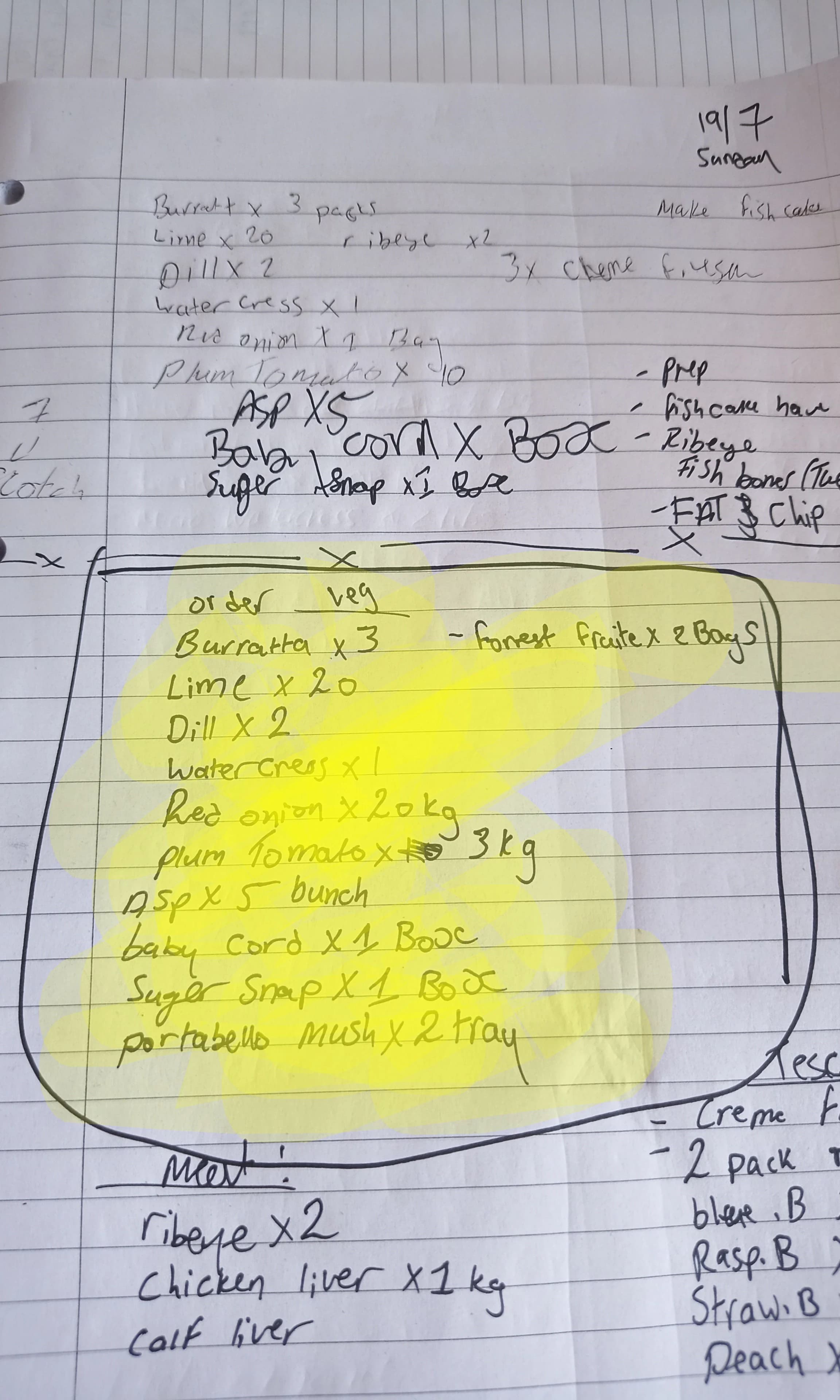
The system isolates the highlighted order while preserving the original image for the reviewer.
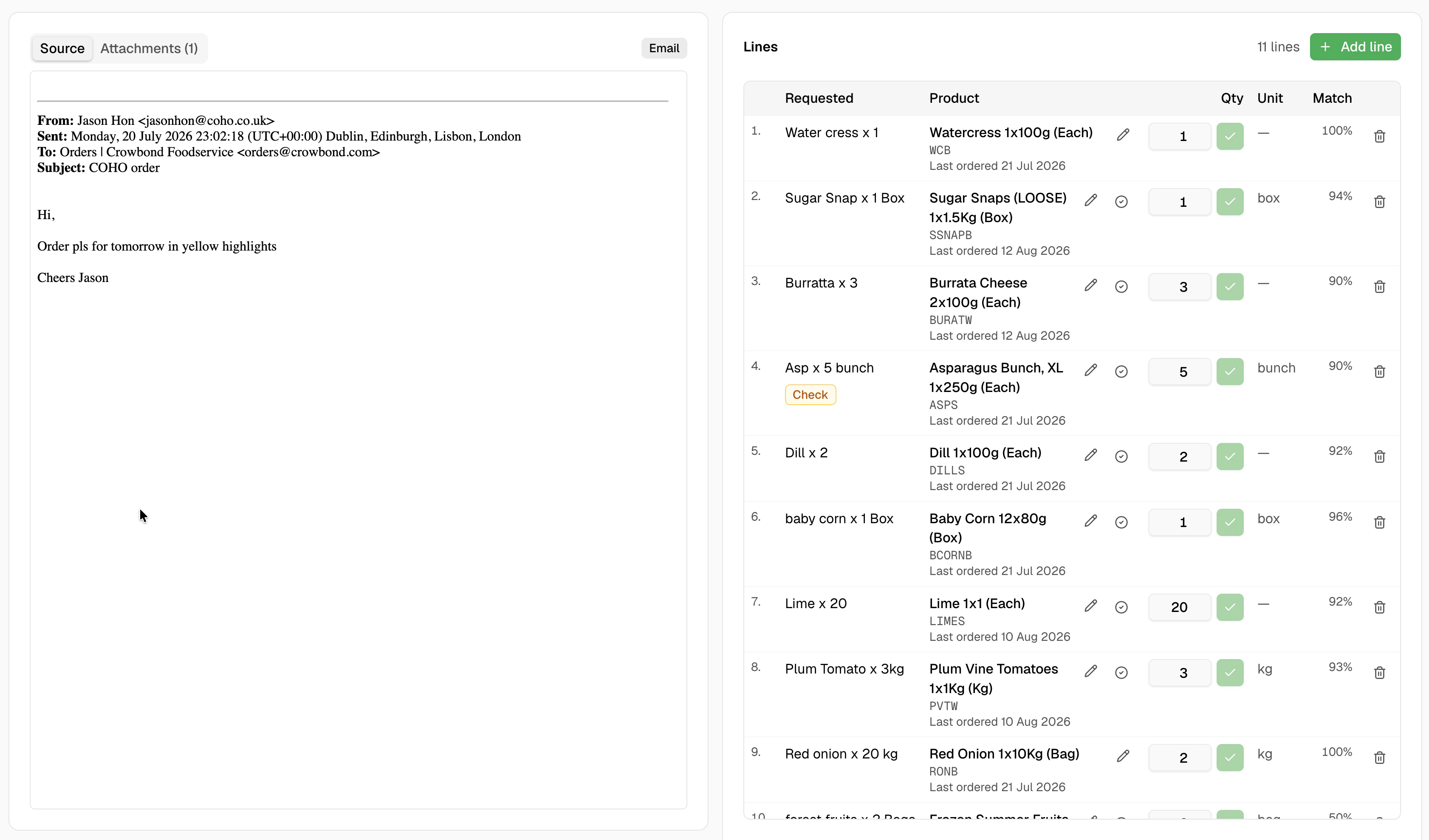
Eleven requested lines arrive with matched products, quantities, units and confidence. Anything that needs judgement remains visibly flagged.
"Red onion x 20 kg" becomes two 10kg bags. The system has done the pack calculation, but the person reviewing the order can still change it before confirmation.
ORBN built AI order processing into Crowbond's existing system. It reads incoming messages, identifies the customer, matches the requested products and works out pack sizes and quantities. Each order arrives ready for a person to check, with uncertain details highlighted. Staff can review and approve orders without typing them in from scratch.
Keep the complete source
Separate orders from inbox noise
Read customers, sites and lines
Resolve phrases to catalogue items
Confirm, correct and remember
The raw email and every attachment are stored before processing begins. PDFs are read, voicemail is transcribed and spreadsheet links are frozen so the source cannot change later. Duplicate deliveries cannot create a second order.
A fast classifier separates orders from out-of-office replies, remittances and delivery queries. Under the standard configuration, it only discards a message when it is at least 85% confident that the message is not an order. If the classifier fails, the message continues.
The first pass finds the customer, site, delivery date and purchase order number. A second pass reads the requested products for each order. This matters when one email contains several deliveries for different venues.
Customer aliases, catalogue search, pack families, order history and a specialist relevance model narrow the options. A reasoning model then chooses from that shortlist, while a pack and unit rule checks the answer.
Each draft lands in the ERP review queue with confidence shown by line. The standard review threshold flags matches below 70%. The reviewer can change the customer, product, unit or quantity before confirming the order.
Confidence thresholds are configurable for each deployment.
A foodservice catalogue can contain thousands of similar products. Search alone may find vine tomatoes but miss the box, or return a punnet when the customer asked for kilos. Sending the whole catalogue to one large model would be slow, expensive and difficult to control.
Each layer does one bounded job. Search finds plausible products. The re-ranker puts the strongest candidates first. The reasoning model makes the final choice with the customer's history in view. The expensive model only sees the questions that need judgement.
The system prepares a draft. A person confirms it before the order becomes live, with uncertain lines and unusual quantities brought to their attention.
Repeated confirmations create a customer-specific alias. Once trusted, the same phrase can resolve immediately without another model call.
When a reviewer rejects a product for a phrase, the system removes that option before the matching model sees the next order.
A later correction resets the learned alias. The system asks for human judgement again instead of preserving an outdated assumption.
Order processing no longer ties up a three-person team. Crowbond handles about 400 orders a day with one reviewer and has redeployed staff to more proactive customer service. Every order still gets a human check before it reaches the warehouse.
One operator can manage the order queue while the system prepares the routine customer and product matches.
Processing orders moved from an almost full-time responsibility to roughly a third of the reviewer's working day.
The workflow sorts approximately 600 incoming messages and prepares the orders within them for review.
Automation removes the repeated reading and typing. Acceptance remains a clear, auditable human action.
“The automation work has meant we can redeploy the people to working more proactively on CS - ensuring customers get the best possible service. We can already see a tangible upward swing in order values”
Results reflect Crowbond's current operation and starting point. The outcome for another wholesaler will depend on order volume, formats, catalogue quality and existing systems.
Each golden fixture pairs an original customer message with the order a person verified as correct. When a prompt, model, search setting or matching rule changes, all 150 fixtures can be replayed through the same pipeline code used in production, with order-creating side effects switched off.
Real messages and attachments paired with the customer and product lines an operator accepted.
Evaluation calls the extraction, customer identification and matching services that serve live orders. Only the operational side effects are disabled.
Extraction, candidate retrieval and final product selection are measured separately instead of being hidden inside one accuracy number.
A batch can repeat the fixture set up to ten times. That reveals variance instead of treating one fortunate answer as the result.
Every run records the code version and the models used. The team can compare one exact code-and-model combination with another and see whether a change improved the complete pipeline or simply moved the error elsewhere.
Each document has a stored state and a deadline for every stage. If work stops, the queue shows where it stopped and why.
Inbound messages and processing steps are idempotent. A repeated webhook or retry reuses the same document instead of creating another order.
Classification failure sends the message forward. Re-ranking failure falls back to search order. Matching failure returns visible lines for review.
Prompts treat text inside emails and attachments as source material, never as instructions to the system.
AI reads customer messages, identifies who is ordering and matches their requested items to the product catalogue. It prepares an order for a person to check and approve, saving staff from reading and typing in every line themselves. At Crowbond, this works with emails, PDFs, photos, spreadsheets and voicemail transcripts.
Crowbond receives about 600 messages a day through the order inbox. Around 400 of those messages contain orders that need to be identified, read, matched to the product catalogue and reviewed.
Yes. A person confirms each order before it becomes a live sales order. The system prepares the routine work and directs the reviewer to uncertain customer or product matches. This reduced the team needed to process orders from three people to one, and that person now spends roughly a third of their working day on it rather than almost all day.
Uncertain lines are flagged for review, and every failure appears in the queue with a reason. If classification fails, the message continues to extraction. If matching fails, the lines remain visible for a person to resolve. The design favours extra review over a missed order.
Confirmed customer phrases, rejected product matches, unit conversions and customer identities are stored as operating knowledge. Repeated phrases can then resolve without another AI call, while a later contradiction sends the phrase back through review.
ORBN maintains 150 golden fixtures built from real, human-verified orders. When the pipeline changes, the fixtures can be replayed through the same code used in production. Extraction, retrieval and product selection are scored separately, so the team can see whether a change improved the whole pipeline or moved a problem from one stage to another.
See how more than 200 daily orders became practical routes in under 20 minutes.
R/02Connect ordering, ERP, warehouse work, delivery planning and reporting.
R/03Build AI into a controlled operational workflow with evaluation and human review.
R/04Move orders, stock and fulfilment data without repeated entry between systems.
R/05Decide whether to buy, integrate or build around the system you already have.
R/06See why rising demand can turn routine administration into a systems decision.
Bring a sample of the messages your customers send and the workflow your team uses today. We'll help you work out where automation is useful, where human judgement belongs and what the first production step should be.