Should you build
or buy your software?
Use this guide to compare fit, speed, control, integration, ownership and three-year cost. The eight-factor scorecard will point towards buying, building or combining both.
A good product should beat a custom build.
Buy when a proven product handles the important work and gets the team moving sooner. Build when the workflow matters to the way your business competes, existing products leave a costly gap and you can own the software after launch. Many operations need both: packaged systems connected to a small amount of custom software.
Standard need, strong product fit
Use the vendor’s product, support and established ways of working. Test your critical scenarios and exit terms before changing the operation to fit it.
Good products, expensive gaps
Keep dependable core software. Build the connection or missing operational step, and give it a clear owner.
Distinctive workflow, justified ownership
Build the part of the operation that creates advantage, control or capacity. Budget for support and future changes as well as delivery.
Compare custom and off-the-shelf software
Scroll horizontally to compare all three columns →
| Factor | Off-the-shelf software | Custom software |
|---|---|---|
| First value | Usually faster once selected and configured | Phased delivery; useful release takes design and build |
| Initial cost | Licence, implementation, configuration and migration | Discovery, design, delivery, migration and release |
| Process fit | Designed for a market; local exceptions use configuration or workarounds | Designed around the chosen workflow and its exceptions |
| Integration | Strong where supported connectors fit; vendor boundaries elsewhere | Can own unusual joins, data flow and failure handling |
| Change | Depends on configuration and the vendor roadmap | Roadmap is controlled by the organisation |
| Ownership | Vendor owns product direction; contract governs access and exit | Organisation owns the asset but must operate and maintain it |
| Assurance | Established controls may reduce effort if they fit the requirement | Controls and evidence can be specific, but must be designed and proven |
| Exit risk | Migration, data export, contract and replacement risk | Knowledge, maintainability, documentation and team continuity risk |
Score one decision, not the whole company.
Ask people from operations, finance, security and technology to score the same workflow separately. The disagreements are often more useful than the total. A recent decision-support paper also found that named, comparable factors can make build-versus-buy decisions easier to explain and review. Read the research paper.
Use evidence from operations, finance, security and technology. A neutral score is not a recommendation.
A hybrid approach may fit best
Buy the standard capability, then connect or build the missing workflow. Decide module by module instead of forcing one answer across the whole operation.
Send the result and your optional context to ORBN for a personal response.
Use this scorecard to structure the conversation. It does not compare actual vendors, prove feasibility or calculate total cost of ownership. Record the reason behind every score.
Keep standard capability standard.
Choose at the level of a workflow or module. A single operation may use all three approaches, but each record and connection still needs an owner.
Use a proven product
Buy when the process is standard, a real product passes your important scenarios and moving quickly matters more than differentiation. It is also the safer option if nobody can own security, support and future changes.
Keep the core and own the connections
Keep established systems of record, name which one owns each record and build only the missing workflow. Document monitoring, retries, reconciliation and who responds when a connection fails.
Build where the gap changes the business
Build when the workflow, integration or level of control changes margin, capacity, service or risk enough to justify the cost. Name the business owner, operating budget and support route before delivery begins.
For example, a wholesaler might buy finance and CRM, keep its order system, connect product and customer records, then build mobile picking and route planning because those workflows affect service and margin. Use ORBN’s API and systems integration scorecard to test whether one of those connections is ready to scope.
Compare the full cost, then test the risk.
Use the same scope and time period for both options. This guide uses three years so the comparison includes licence, support and change costs. Keep the assumptions visible because neither estimate is certain.
The licence is only the first line
Include implementation, configuration, add-ons, users, usage, integration, internal administration, manual workarounds, contract increases, migration and exit.
Delivery is not the final line
Include discovery, delivery, migration, cloud, monitoring, security, support, product change, knowledge continuity and eventual replacement.
Use the UK custom software cost estimator
Test both options with a real scenario
A feature checklist hides the details that create manual work. Use the same real case to test a packaged product and the riskiest assumption behind a custom build.
Choose one representative case
Use a real order, customer, product, approval or service request with realistic volume and history.
Include the awkward exception
Add the substitution, reversal, late change, permission boundary or failed integration that creates manual work today.
Follow the data through the process
Show where every record starts, changes, reconciles, exports and remains accessible after the contract ends.
Price the missing work
Separate configuration, customisation, third-party tools, integration and permanent manual steps from the core licence.
Test the custom option too
Prototype the riskiest connection or rule and put it in front of users before treating the estimate as dependable.
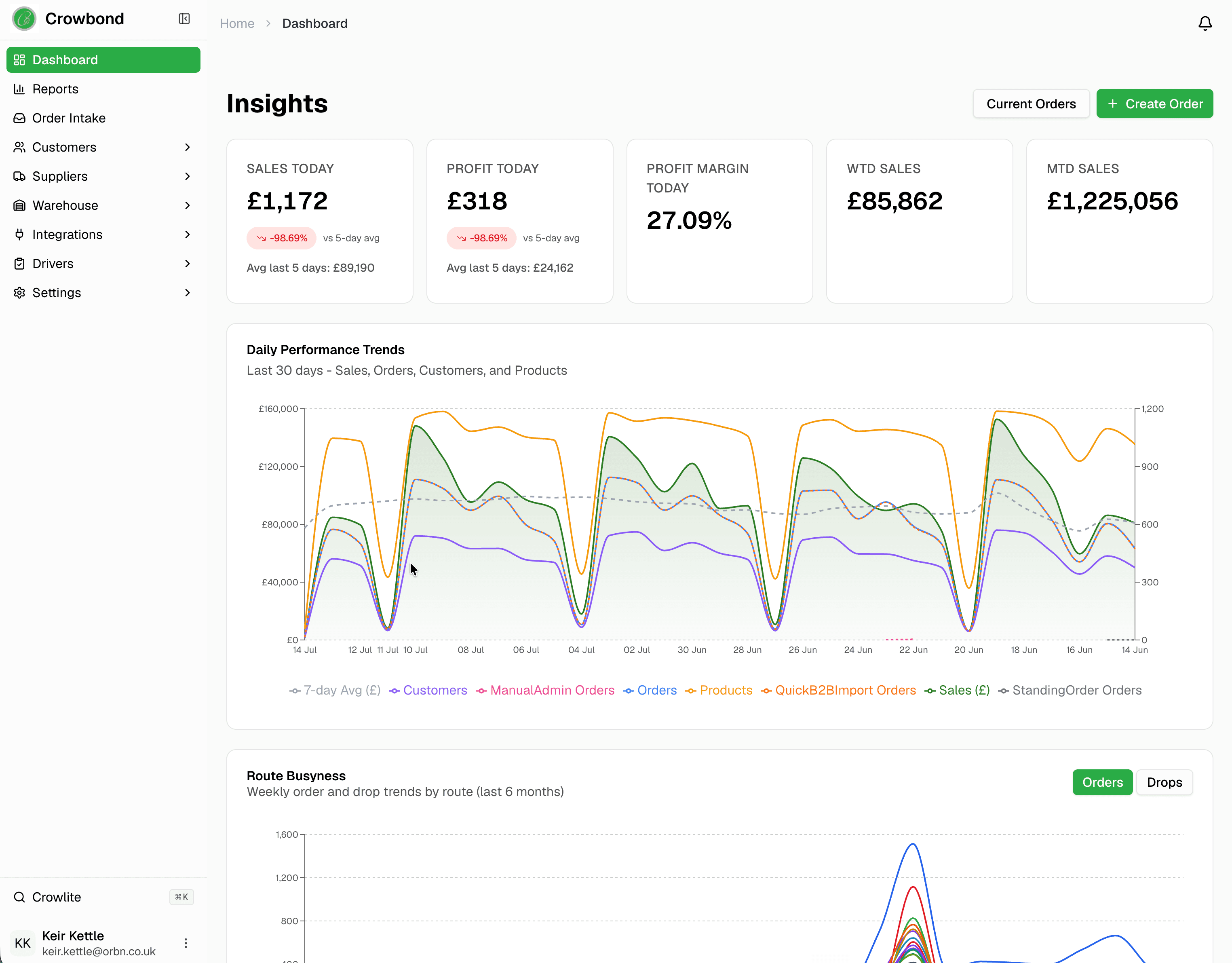
Crowbond kept the core and built the gap.
Crowbond Foodservice had an existing order system and did not need to rebuild it. A packaged route-planning product had been trialled at £4,500 per month, but poor integration left manual work. ORBN built the missing optimisation workflow around the system already in place.
Integrate and build selectively
Retain the order record, automate geocoding and optimisation, preserve human override and reuse existing authentication.
Eight hours to under 20 minutes
Planning for more than 200 daily orders fell to a reviewable step, with over £36,000 reported annual savings.