Website structure & design
Shape the audience, offer, pages, navigation and calls to action, then create a responsive design around the business rather than a generic sector template.
A professionally designed website for £40 per month + VAT, with no upfront build cost. ORBN works with Suffolk sole traders and small businesses to turn their services, proof and personality into a clear website—with hosting and ongoing support from a local software team.
Shape the audience, offer, pages, navigation and calls to action, then create a responsive design around the business rather than a generic sector template.
Organise services, locations, process, proof, frequently asked questions and contact details so prospective customers can understand fit and act confidently.
Set descriptive page information, crawlable structure, useful links, images and local business signals, with clear limits on what launch SEO can promise.
Keep the site online and supported through the monthly service, with the agreed change process and any additions outside the standard scope made explicit.
Pages begin with the customer, service, evidence and next action. Visual design makes that story distinctive and usable instead of masking an unclear offer.
We make the site understandable and technically discoverable, explain what local visibility also depends on and do not sell a guaranteed position in Google.
The monthly offer, website scope, content responsibilities, support, ownership, additions and exit terms are agreed before work begins—not discovered after launch.
ORBN’s offer is designed for small businesses that need a credible, supported website but do not want to become part-time web designers or fund a one-off build before the site exists.
A design shaped around your business, customer and content rather than asking you to adapt a generic template without support.
The standard website build is funded through the £40 monthly service. Any non-standard cost must be identified and agreed before it is incurred.
The site stays hosted and supported within the agreed service boundary, with a clear route for questions, corrections and separately scoped additions.
Work with ORBN from Great Barton, near Bury St Edmunds, with the option to discuss the business and content locally rather than through a faceless builder flow.
The written proposal and service agreement control the actual project. Confirm pages, content, revisions, support, domain, third-party fees, ownership, notice and handover before proceeding. The monthly price does not imply that every website feature is included.
Score the brief for your first launch or redesign. A good website can make a clear business easier to understand; it cannot invent a trustworthy offer, customer evidence or accurate local information after the design is complete.
Every slider starts at 1 for an unproven assumption. Score the information available now—not what you expect to create after design begins.
Design would currently hide unresolved questions about audience, service, proof or ownership. A short content and customer workshop is the useful first step before deciding page layouts.
Send the result and your optional context to ORBN for a personal response.
This scorecard is directional. It does not confirm eligibility for the offer, final scope, accessibility conformance, search ranking or a launch date.
Explain expertise, services, process and evidence; answer common questions; and make a call, email, quote request or consultation the obvious next action.
Show the work, locations served, contact and availability information, trust signals and the details a customer needs before requesting a visit or estimate.
Give referred prospects a credible place to understand the problem solved, types of client, working approach and route to a useful first conversation.
Launch from a clear brief, or replace a self-built site that no longer reflects the quality, personality or current offer of the business.
Ecommerce, membership, customer accounts, complex booking, live availability or payments introduce product, data, security and support decisions beyond an information site.
Quoting engines, portals, CRM workflows, marketplace features and integrations may be valuable, but should be treated as software rather than hidden inside a cheap website promise.
The cheapest subscription is not automatically the lowest-effort route, and a bespoke build is not automatically better. Choose from the business outcome, content, control, time and feature complexity you actually have.
Scroll horizontally to compare website routes →
| Route | Useful when | You still own | Check before committing |
|---|---|---|---|
| Do-it-yourself website builder | You have time, confidence and simple content, and want direct editing control | Template choice, writing, images, setup, accessibility, search details and maintenance | Low subscription price can hide the owner’s time and an unfinished content job |
| ORBN £40/month offer | A focused service-business website needs professional design, hosting and support without an upfront build cost | Business facts, approvals, evidence and agreed requests outside the standard scope | The written scope must define pages, support, ownership, additions and exit |
| One-off freelance or agency build | You can fund the build upfront and need a defined design or CMS project | Hosting, updates, security and future supplier arrangements after handover | A low build quote may exclude content, licences, maintenance or launch work |
| Custom website or web application | Transactions, accounts, integrations or a distinctive digital workflow create material value | Product decisions, budget, data, security, operation and ongoing development | Treating software complexity as a few extra pages creates cost and support surprises |
“Website included” leaves too much room for different assumptions. ORBN’s project confirmation should make the following items inspectable so a small business knows what it is approving and paying for.
Page list, purpose, navigation, enquiry routes, who supplies and approves words and images, any copy or asset work included, and legal or sector information the business must verify.
Brand inputs, responsive design approach, review stages, number or type of revision, feedback owner and what happens when new requirements appear after approval.
Who registers and controls the domain, DNS and email; which accounts the business can access; renewal responsibility; and how changes are authorised securely.
Hosting boundary, certificates, backups or recovery where applicable, monitoring, software maintenance, contact route, supported changes, response expectations and urgent-issue handling.
Technical and on-page search work, analytics or Search Console setup, cookie or privacy responsibilities, local-profile work, ongoing SEO exclusions and who receives the accounts and data.
£40/month + VAT terms, separately chargeable work or products, review expectation, notice, outstanding fees, design and code rights, content export, domain transfer and handover support.
A small site does not need a heavyweight agency process, but skipping the brief moves uncertainty into design revisions. The work stays compact by resolving audience, content and approval in the right order.
Discuss the business, customers, current presence, goals, features and timing. Confirm whether the £40/month offer fits or whether the requirement needs a different scope.
Identify the primary audience, services, locations, questions, proof, brand assets and next action. Assign an owner for accurate, approved business information.
Define each page’s job, headings, navigation and call to action. Keep content useful for a visitor instead of creating pages solely to repeat nearby town names.
Create a responsive visual system around the real content and brand personality. Review one coherent direction before multiplying layouts and decorative options.
Implement semantic, mobile-friendly pages; check navigation, forms, images, metadata, links, performance and representative accessibility needs; and resolve launch blockers.
Confirm names, services, claims, prices, contact and policy details; connect the agreed domain and measurement accounts; record a rollback route; and publish.
Keep business information current, review enquiries and search evidence, address supported changes, and scope any new capability without destabilising the focused site.
Local visibility is not created by hiding town names in a footer. The website, real-world business information, reputation and eligible Google Business Profile should describe a consistent service and location truthfully.
Use clear titles and headings for the service, audience and genuine location or service area. Give each page a distinct purpose and enough useful information to support a decision.
Publish accurate contact and service details, a real process, relevant work or reviews with permission, credentials and answers to the questions customers ask before enquiring.
Provide working links, indexable text, descriptive image context, canonical page information and a logical site structure. Avoid duplicate doorway pages for every nearby place.
Keep text readable, navigation and controls usable, keyboard and focus behaviour clear, form labels meaningful and content available without relying only on colour or animation.
Eligible customer-facing or service-area businesses should verify and maintain their Google Business Profile, categories, hours, contact details, photos and authentic reviews.
Use agreed analytics, Search Console, profile performance and enquiry evidence to learn which pages and searches help. Allow weeks or months before judging organic effects.
Google’s official guidance says SEO helps search engines understand content and users decide whether to visit, but does not guarantee indexing or first place. Read the Google SEO Starter Guide and its explanation of local ranking through relevance, distance and prominence in the Google Business Profile guidance.
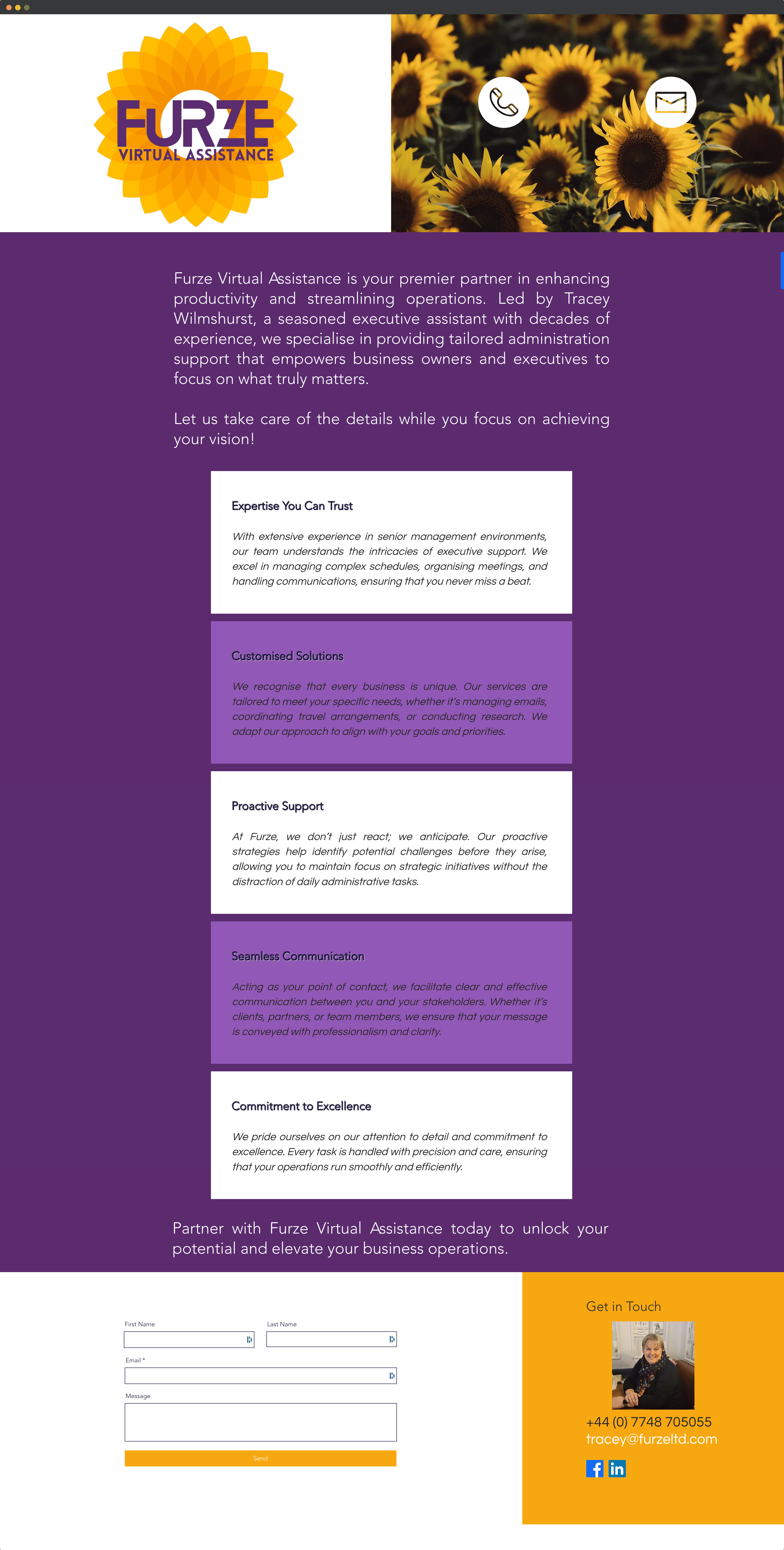
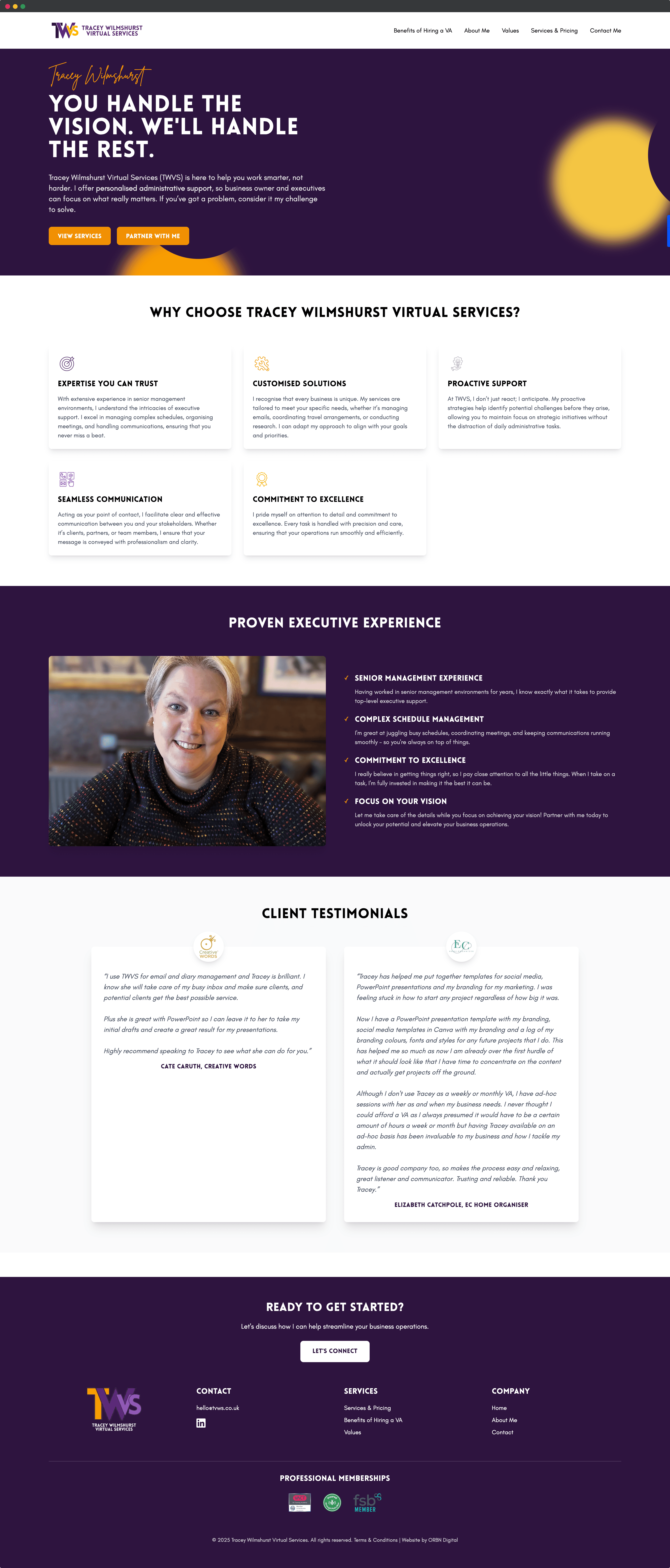
Tracy had built the previous website using Wix, but felt it no longer conveyed the professionalism, warmth or attention to detail of the virtual-assistance service. ORBN restructured the presence around clearer services, a visible next action and a visual direction aligned with how Tracy works with clients.
View the live business website at twvs.co.uk. This example demonstrates design and content work; it does not claim a guaranteed conversion or search result for another business.
A focused site can remain the front door while supported products handle booking, payments, email or CRM. Bespoke software becomes sensible when the workflow is distinctive enough to justify its build and operating cost.
New service pages, case studies, local content, research and digital PR require recurring evidence and editorial ownership. They are not automatically included in launch foundations.
Use supported services where they fit, then define data, consent, notifications, failure and account ownership before connecting them to enquiries.
Products, stock, delivery, tax, returns, payment, fraud, support and platform fees create an operating model that needs separate selection and scope.
Accounts, documents, quotes, orders and operational integrations are software products. Start with the user, workflow, data and security rather than adding plugins one at a time.
The advertised offer is £40 per month plus VAT with no upfront website build cost. Before work starts, ORBN confirms the website scope, payment start, minimum or notice terms, content responsibilities, hosting and support boundary, ownership and any separate third-party or additional-feature cost in writing. A larger ecommerce, booking, membership or custom-software requirement may need a different proposal rather than being forced into the standard offer.
The offer covers a professionally designed small-business website, hosting and ongoing support within the agreed standard scope. The written proposal should name the pages and functionality, design and revision process, launch work, supported updates, response route, domain and email responsibilities, analytics or consent setup, and what counts as an addition. This page explains the intended service, but the signed scope is the source of truth for an individual project.
ORBN created the monthly offer to help small businesses improve their online presence without a build bill and to develop evidence and independent reviews for this service. After delivery, ORBN may ask the client to describe their honest experience on a review platform such as Clutch. The request should be for an authentic review rather than a particular rating, and any expectation connected to the offer should be stated before the client agrees.
The best fit is usually a sole trader or small service business that needs to explain what it does, where it works, why customers should trust it and how to enquire. Examples include professional services, consultants, trades, local providers and small B2B businesses. A complex store, customer account area, marketplace, real-time quote engine, multi-location platform or operational application should be scoped separately.
The business remains the authority for its services, claims, prices, locations, legal information and permission to use customer evidence or images. ORBN helps structure that material and makes the required inputs clear. Copywriting, brand identity, illustration, photography or substantial content creation should be named explicitly if needed, because design cannot compensate for missing or unapproved business information.
No responsible provider can guarantee a particular organic or local position. ORBN can build clear, crawlable pages with descriptive titles, useful content, internal links, mobile layouts and sensible technical foundations. Visibility also depends on competition, relevance, location, reputation, links, reviews and ongoing content. Eligible local businesses should maintain an accurate Google Business Profile. Search performance takes time and should be measured after launch.
Yes, subject to feasibility and a separate agreed scope where the change sits outside the standard service. Possible additions include enquiry integrations, newsletters, analytics, booking, payments, customer portals, blogs and custom workflows. ORBN first checks whether a supported third-party product is the sensible route. Feature licences, transaction charges, content and ongoing operation should remain visible before implementation.
Ownership, access, cancellation, export and handover should be explicit in the written agreement before work begins. The business should know who registers and controls the domain, who owns supplied text and images, what rights apply to design and code, which accounts it can access, how much notice is required, what remains payable and what ORBN will provide at exit. Ask for these terms rather than assuming a monthly website works like a self-service builder.
Meet ORBN in Great Barton for local software discovery, process mapping and technical review.
R/02Build customer portals, operational systems and web applications when the need goes beyond an information website.
R/03Model team, duration and risk when an account, workflow or integration becomes a genuine software project.
R/04Compare a supported product, integration and bespoke build before funding distinctive website functionality.
R/05See the senior engineers and system thinkers behind ORBN’s local design and software work.
R/06Find the Great Barton office details and start a conversation about your website or software need.
Bring your services, customers, current website or blank page. We’ll confirm whether the £40/month offer fits and set out the content, scope and responsibilities before design starts.